 EN
EN

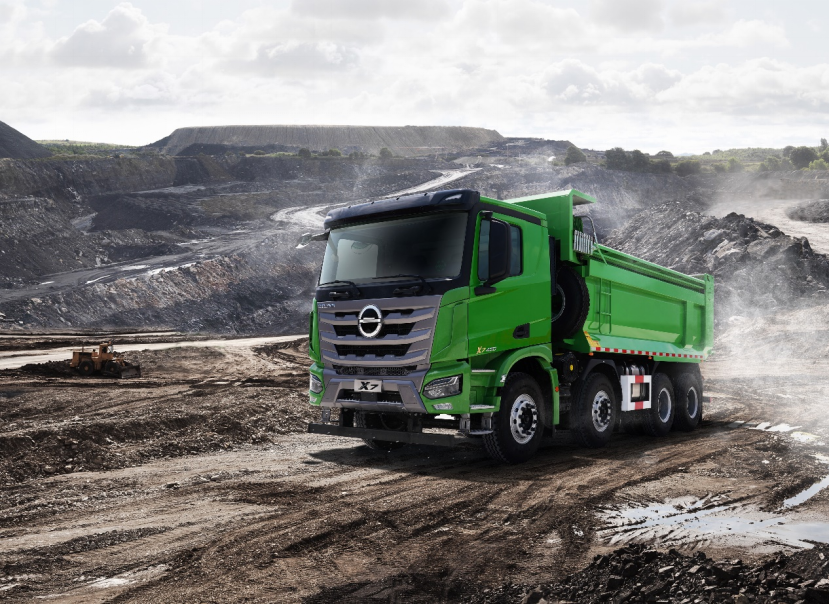
Operational Efficiency and Safety Advantages of Dump Trucks
Hydraulic dumping mechanism and real‑time load control for safer, faster material discharge
The hydraulic dumping system enables rapid unloading of aggregate, soil, or debris—often in under 15 seconds—cutting cycle times significantly compared to manual offloading. Modern hoist-by-wire controls and in-cab load-weighing sensors provide operators with real-time feedback on bed angle and weight distribution, helping prevent overloads and unstable lifts. Integrated stability-control algorithms automatically modulate hoist speed if vehicle tilt exceeds safe thresholds, reducing tip-over risk on uneven ground. Complementing these systems, backup cameras, 360-degree proximity sensors, and audible travel alarms alert ground crews during reversing or dumping—enhancing situational awareness without requiring workers to enter hazardous zones. By eliminating manual material handling, this integrated safety architecture reduces strain-related injuries while maintaining high throughput. As outlined in OSHA’s Guidelines for Heavy Equipment Operations, such layered safeguards—hydraulic precision, electronic monitoring, and proximity awareness—are now industry benchmarks for safe, efficient earthmoving.
Rugged chassis and off‑road capability ensuring reliable performance on unstable or ungraded construction terrain
A dump truck’s durability stems from its engineered resilience: a rigid ladder-type or boxed chassis distributes payload stress evenly; heavy-duty suspension and high-flotation tires maintain traction across mud, gravel, steep slopes, and freshly graded surfaces; and high ground clearance—often exceeding 300 mm on articulated models—protects critical components from impact damage. Mounting the bed within the frame rails lowers the centre of gravity, improving lateral stability when fully loaded over rough terrain and directly reducing rollover risk. Optional all-wheel drive and differential locks further enhance mobility on soft or slippery substrates by maximizing torque delivery where grip exists. This rugged integration eliminates dependence on temporary haul roads and allows direct cut-to-fill movement—reducing handling steps, equipment coordination, and schedule delays. For projects with ungraded access or weather-vulnerable conditions, this capability delivers continuity and safety that lighter transport vehicles cannot match.
Payload Capacity and Hauling Performance Across Construction Scenarios
Optimizing haul efficiency: standard (10–20 ton) vs. articulated (30–45 ton) dump truck configurations
Dump truck selection directly shapes site productivity through payload-to-cycle-time ratios. Standard rigid-frame models—typically rated for 10–20 tons—excel in residential construction, utility trenching, and confined urban sites where maneuverability, lower ground pressure, and compatibility with paved infrastructure outweigh volume demands. Their reduced gross vehicle weight rating (GVWR) minimizes pavement damage and permits operation in sensitive areas without special permits.
Articulated dump trucks (ADTs), rated for 30–45 tons, are purpose-built for large-scale earthmoving, mining, and highway grading. Their tractor-trailer articulation and six-wheel drive distribute axle loads effectively on soft or uneven subgrades, preventing bogging that stalls smaller units. A 2023 productivity analysis of a 200,000-ton cut-and-fill operation found ADTs reduced total haul trips by 60% versus 15-ton standard trucks—lowering fuel use per ton-kilometre and cutting emissions. Matching payload capacity to job scope avoids overspeccing (which inflates capital and operating costs) and underspeccing (which risks overload violations and accelerated driveline wear). Regional adoption reflects this logic: Asia-Pacific markets favour mid-range 10–20-ton models for dense urban infrastructure, while North American and European contractors increasingly deploy 30-ton-plus ADTs for Tier 4 Final-compliant highway and energy projects.
Cycle time advantage over front-end loaders and conveyors—validated by ASTM E2914-22 field benchmarks
Haul cycle time—encompassing loading, travel, dumping, and return—determines hourly material output. On mid-to-long hauls (>200 m), dump trucks consistently outperform alternatives. Front-end loaders lose efficiency beyond short distances due to idle time and limited reach; portable conveyors offer continuous flow but lack flexibility for shifting dump points or variable terrain. ASTM E2914-22 provides a standardized method for measuring earthmoving equipment cycle-time variability—and field studies applying it confirm dump trucks’ superiority. In a controlled 2023 comparison, a 35-ton ADT completed a 1.5-km round-trip cycle 25% faster than a loader-plus-truck arrangement and 40% faster than a portable conveyor traversing identical terrain. This translates to ~180 additional tons moved per truck per day in typical quarry operations—directly accelerating milestone achievement. With travel speeds up to 55 km/h on haul roads and hydraulic quick-dump capability, dump trucks deliver the lowest cost-per-tonne-moved metric for dynamic sites where load-out and dump locations shift frequently.
Versatility in Terrain Adaptability and Material Handling
All-wheel drive, differential locks, and high ground clearance for consistent operation on mud, gravel, slopes, and rough grading
Three core engineering features enable dependable off-road performance: all-wheel drive ensures torque is delivered to all axles, maintaining forward momentum on mud or loose gravel; differential locks eliminate wheel-speed variance, directing power to wheels with available traction—critical on steep or uneven grades; and high ground clearance protects vulnerable components like transmission sumps and hydraulic lines from impact on freshly graded or rutted surfaces. These systems work synergistically so the truck can safely discharge material precisely at the designated location—even after navigating wet borrow pits or soft fill zones. The result is predictable cycle times, fewer reroutes, and minimal reliance on supplemental grading or support equipment. As noted in the American Association of State Highway and Transportation Officials (AASHTO) Guidelines for Off-Road Vehicle Operations, this level of integrated terrain adaptability is essential for maintaining productivity and safety on unprepared job sites.
Cost Effectiveness and Project-Level Impact of Dump Truck Deployment
Total cost of ownership: 18–24 month ROI from reduced subcontracted hauling, fuel-efficient Tier 4 Final engines, and lower maintenance downtime
Total cost of ownership (TCO) for modern dump trucks extends far beyond acquisition—yet delivers compelling financial returns. While heavy-duty models may cost up to $300,000, contractors replacing subcontracted hauling typically achieve full ROI within 18 to 24 months. The primary driver is eliminating per-load rental fees averaging $2,500–$3,000 weekly for a single unit. Tier 4 Final diesel engines reduce fuel consumption by 5–10% versus prior generations, lowering variable operating costs. Telematics-driven predictive maintenance further improves economics: unscheduled repairs drop by up to 25%, according to Caterpillar’s 2023 Fleet Performance Report. Together, these factors make owned dump truck fleets a financially predictable, scalable solution for high-volume earthmoving—especially when factoring in avoided scheduling penalties, insurance premiums, and equipment coordination overhead.
Contribution to schedule adherence and infrastructure scalability—case examples from highway and site-development projects
Dump trucks strengthen schedule adherence by compressing material transport cycles. On a major U.S. highway expansion, switching from front-end loaders to a fleet of articulated dump trucks cut average haul-cycle duration by 40%, enabling the project to finish two weeks ahead of the critical path. In site-development work, moving 30–45 tons per trip allows one ADT to replace multiple smaller units—keeping grading, base preparation, and backfill stages tightly synchronized. Large infrastructure programs demonstrate scalability: during the Panama Canal expansion, automated hauling—including advanced ADTs—reduced overall project completion time by nearly 20%. This operational agility lets contractors accelerate phase completions and scale hauling capacity seamlessly—whether managing a 10-km corridor or coordinating multi-parcel development logistics—without adding complex equipment dependencies or retraining overhead.
FAQ
What are the key safety features of modern dump trucks?
Modern dump trucks are equipped with hydraulic dumping systems, hoist-by-wire controls, in-cab load-weighing sensors, backup cameras, and stability-control algorithms to ensure safer and faster operations, preventing overloads and reducing tip-over risks.
Why are dump trucks preferred for large-scale earthmoving?
Dump trucks, especially articulated models, are preferred for their large payload capacity, effective axle load distribution, and ability to work efficiently on soft or uneven terrain, significantly lowering fuel consumption and emissions compared to smaller standard trucks.
How do dump trucks ensure cost efficiency for construction projects?
Dump trucks offer cost efficiency by reducing subcontracted hauling fees, optimizing fuel consumption with Tier 4 Final engines, and lowering maintenance costs through predictive maintenance, achieving a return on investment within 18 to 24 months.